
checkmate
Checkmate is a Spec Oracle Engine built for AI-driven development. It verifies that code changes made by autonomous agents actually deliver what your spec promised using real evidence.
Repository Info
About This Server
Checkmate is a Spec Oracle Engine built for AI-driven development. It verifies that code changes made by autonomous agents actually deliver what your spec promised using real evidence.
Model Context Protocol (MCP) - This server can be integrated with AI applications to provide additional context and capabilities, enabling enhanced AI interactions and functionality.
Documentation
# CheckMate | [](https://www.npmjs.com/package/checkmateai) [](https://github.com/richardsondx/checkmate/stargazers)
By [@Richardsondx](https://x.com/richardsondx)
[](https://youtu.be/fM8DmUkt7WY)
AI-powered specs verification that block bad code, see through hallucination, and prevent AI from breaking your code.
CheckMate is an AI Test Driven Development tool that challenges AI's overconfidence with a logical reasoning verification process using LLM.
It's built with Cursor AI in mind.
## Requirements
CheckMate works best with both API keys:
- **OpenAI API Key**: Required for GPT models (default `quick` verifier)
- **Anthropic API Key**: Required for Claude models (default `reason` generator)
## Quick Setup
```bash
# Install globally
npm install -g checkmateai
# Initialize in your project
npx checkmateai init
```
That's it! `checkmate init` takes care of everything - creating directories, config files, and setting up Cursor integration.
It will setup your app and generate a checkmate rules folder with all the necessary rules:
These rules will include:
- pre-task.mdc - Runs before each task
- post-task.mdc - Runs after each task
- post-push.mdc - Runs after each push
- spec-assistant.mdc - Helps with spec creation and format guidance
- spec-linter.mdc - Automated linting and fixing of spec files
- verification-trigger.mdc - Triggers feature verification workflow
- autofix-enforcer.mdc - Enforces auto-fix attempts on failures
- drift-detector.mdc - Detects spec-vs-code drift
- non-interactive-mode.mdc - For headless CheckMate runs
- ai-feature-validation-guidelines.mdc - Instructional guide for AI validation
- ai-verify-llm-reasoning-workflow-docs.mdc - Documentation for LLM reasoning workflow
After initialization, add your API keys to the auto-generated `.checkmate` file:
```yaml
openai_key: sk-**** # Your OpenAI API key
anthropic_key: sk-ant-**** # Your Anthropic API key
```
For detailed explanations of what happens during initialization or for manual setup instructions, see the [Initialization Process](wiki/Initialization-Process.md) guide.
## MCP Integration
CheckMate can be set up as a Middleware Control Protocol (MCP) server for deep Cursor AI integration, enabling a seamless TDD experience directly in your editor:
```bash
# Set up the MCP integration automatically
npx checkmate setup-mcp
```
This creates or updates your `.cursor/config.json` file with the necessary MCP configuration:
```json
{
"mcpServers": {
"checkmate": {
"command": "node",
"args": [
"dist/mcp/index.js"
],
"env": {}
}
}
}
```
The MCP server automatically reads configuration values (including API keys and model preferences) directly from your `.checkmate` file, eliminating redundant configuration and potential inconsistencies.
With MCP integration:
- Simply describe what you want to build in Cursor ("Build a login form")
- CheckMate automatically generates specs and runs checks
- Cursor implements the code against the generated requirements
- Checks are verified to ensure the implementation matches the specification
For detailed MCP configuration options, see the [Cursor Integration Guide](wiki/Cursor-Integration.md).
## Configuration
CheckMate uses your local `.checkmate` file for configuration. This file is never committed to version control (it's automatically added to `.gitignore`).
While you can run with just one key, the recommended configuration uses both:
```yaml
# In .checkmate file
openai_key: sk-**** # Your OpenAI API key
anthropic_key: sk-ant-**** # Your Anthropic API key
```
CheckMate uses each model for different purposes:
- **Claude models** (Anthropic): Primarily used for spec generation and detailed reasoning (`reason`)
- **GPT models** (OpenAI): Primarily used for quick requirement verification (`quick`)
This dual-model approach ensures:
1. Higher quality spec generation (Claude excels at reasoning)
2. Faster verification cycles (GPT models are typically quicker)
3. Cost optimization (using the right model for each task)
### Additional Configuration Options
```yaml
# Model selection
models:
reason: claude-3-7-sonnet-20250219 # For spec generation (complex reasoning)
quick: gpt-4o-mini # For requirement verification (faster)
# File discovery
tree_cmd: "git ls-files | grep -E '\\.(ts|js|tsx|jsx)$'"
context_top_n: 40 # Top relevant files to include
# Behavior settings
protect_specs: true # Detect spec tampering
auto_fix:
max_attempts: 5 # Auto-fix attempts before human intervention
# See wiki/Configuration-Guide.md for complete options
```
For full configuration details, see the [Configuration Guide](wiki/Configuration-Guide.md).
### Environment Variables
Instead of storing API keys in the `.checkmate` file, you can use environment variables:
```bash
# Add to your .env file or set in your shell
export OPENAI_API_KEY=sk-...
export ANTHROPIC_API_KEY=sk-ant-...
```
CheckMate will automatically detect and use these environment variables if present.
### AI Integration and Token Usage
CheckMate supports both User Specs (Markdown) and Agent Specs (YAML) that work together to validate your code. Learn more about when to use each in the [Spec Types Guide](wiki/Spec-Types.md).
#### AI Operations and Token Usage
CheckMate strategically uses AI for specific operations to balance quality and cost:
| Operation | Model Used | Token Usage | When It Happens |
|-----------|------------|-------------|-----------------|
| **Spec Generation** | `reason` (claude-3-sonnet) | High | Only when you run `gen`, `draft`, or `warmup` commands |
| **Requirement Verification** | `quick` (gpt-4o-mini) | Medium | During `status` and `verify` operations |
| **Clarification** | `reason` (claude-3-sonnet) | Medium-High | Only when explicitly using `clarify` command |
#### Cost Optimization Features
CheckMate includes several features to minimize API costs:
- **Smart Caching**: Results are cached in `.checkmate/cache/` to avoid redundant API calls
- **File Hashing**: Only re-verifies requirements when files actually change
- **Selective Execution**: Commands like `affected` only check specs related to changed files
- **Token Usage Tracking**: Run `checkmate stats` to monitor your API usage and costs
You can also swap models to control costs:
```bash
# Use a cheaper model for quick verifications
checkmate model set quick gpt-3.5-turbo
# Use a more powerful model for spec generation
checkmate model set reason claude-3-haiku
```
---
## Core Commands
| Command | Description |
|---------|-------------|
| `checkmate warmup` | Scan repo, analyze code patterns, and suggest specs |
| `checkmate gen "<sentence>"` | Create a regular markdown spec from plain text |
| `checkmate gen "<sentence>" --agent` | Create an agent spec (YAML) from plain text |
| `checkmate gen -i "<sentence>"` | Interactive spec generation with approval workflow |
| `checkmate gen -i "<sentence>" --agent` | Interactive agent spec generation with approval workflow |
| `checkmate draft "<sentence>"` | Generate spec drafts as JSON without writing to disk |
| `checkmate save --json '<json>'` | Save approved spec drafts to disk |
| `checkmate status --target <spec>` | Check spec status, report passes/failures |
| `checkmate next` | Run the first unchecked step in the current branch |
| `checkmate affected` | Print spec names touched by the current diff |
| `checkmate clarify <slug>` | Explain why a requirement is failing and suggest fixes |
| `checkmate watch` | Live ASCII dashboard that updates in real-time as specs run |
| `checkmate watch --filter todo` | Dashboard filtered to specs containing "todo" |
| `checkmate watch --spec user-auth --until-pass` | Watch a specific spec until it passes |
| `checkmate model set quick gpt-4o-mini` | Swap the model in the config |
| `checkmate stats` | Display token usage and estimated costs |
| `checkmate run-script <script-name> [...args]` | Run internal CheckMate utility scripts with proper paths |
---
## Quick Tips
Need to...? | Try this:
------------|----------
**Create a specification** | `checkmate gen "User can reset their password"`
**Create an agent spec** | `checkmate gen "User can reset their password" --agent`
**Check spec status** | `checkmate status --target user-password-reset`
**Focus on a specific spec** | `checkmate status --target user-password-reset`
**Monitor progress** | `checkmate watch` (in a separate terminal)
**Watch a specific feature** | `checkmate watch --spec user-auth --until-pass`
**Fix failing specs first** | `checkmate watch --status FAIL`
**See which specs changed** | `checkmate affected`
These commands cover 90% of your daily CheckMate workflow. For more options, use `--help` with any command.
---
## Configuration (`.checkmate`)
```yaml
openai_key: sk-****
models:
reason: o3
quick: gpt-4o-mini
tree_cmd: "git ls-files | grep -E '\\.(ts|js|tsx)$'"
log: optional # on | off | optional
```
Change model names any time and commit nothing sensitive.
## Visual Task Indicators in Cursor
CheckMate provides clear visual indicators when tasks are running in Cursor:
Each task type has a distinct visual style:
| Task Type | Visual Indicator | Description |
|------------|---------------------------------------|----------------------------------|
| pre_task | 🔍 **SCOPE ANALYSIS** (blue border) | Analyzes which specs will be affected by changes |
| post_task | ✓ **VERIFICATION** (green border) | Verifies that affected specs pass after changes |
| post_push | 🚀 **REGRESSION TEST** (red border) | Ensures all specs pass before pushing to main |
These visual indicators make it immediately obvious when CheckMate is running tasks in Cursor, providing a seamless and integrated experience.
---
## 📜 Cursor Rule Files
CheckMate automatically injects several `.mdc` rule files into your `.cursor/rules/checkmate/` directory during initialization. These rules improve Cursor's understanding of the CheckMate workflow and provide clear guidance about when and why commands are being executed.
The rules include:
* `pre-task.mdc` - Analyzes scope and determines which specs are affected by changes
* `post-task.mdc` - Verifies affected specs and applies auto-fixes as needed
* `post-push.mdc` - Runs full test suite on pushes to prevent regressions
* `spec-assistant.mdc` - Helps with spec creation and format guidance
* `spec-linter.mdc` - Automated linting and fixing of spec files
* `verification-trigger.mdc` - Triggers feature verification workflow
* `autofix-enforcer.mdc` - Enforces auto-fix attempts on failures
* `drift-detector.mdc` - Detects spec-vs-code drift
* `non-interactive-mode.mdc` - For CI/CD or headless CheckMate runs
* `ai-feature-validation-guidelines.mdc` - Instructional guide for AI validation
* `ai-verify-llm-reasoning-workflow-docs.mdc` - Documentation for LLM reasoning workflow
These rules follow Cursor's best practices with short, specific bullets and clear execution steps. View them in `.cursor/rules/checkmate/` to understand how CheckMate integrates with your development workflow.
## Reset and Logs
* After a full‑pass run CheckMate rewrites every `[🟩]` or `[🟥]` back to `[ ]`.
* History lives in `checkmate/logs/run.log` unless `log: off`.
Logs stream nicely into your dashboard or CI summary.
## Contributors
<a href="https://github.com/richardsondx/checkmate/graphs/contributors">
<img src="https://contrib.rocks/image?repo=richardsondx/checkmate" alt="CheckMate project contributors" />
</a>
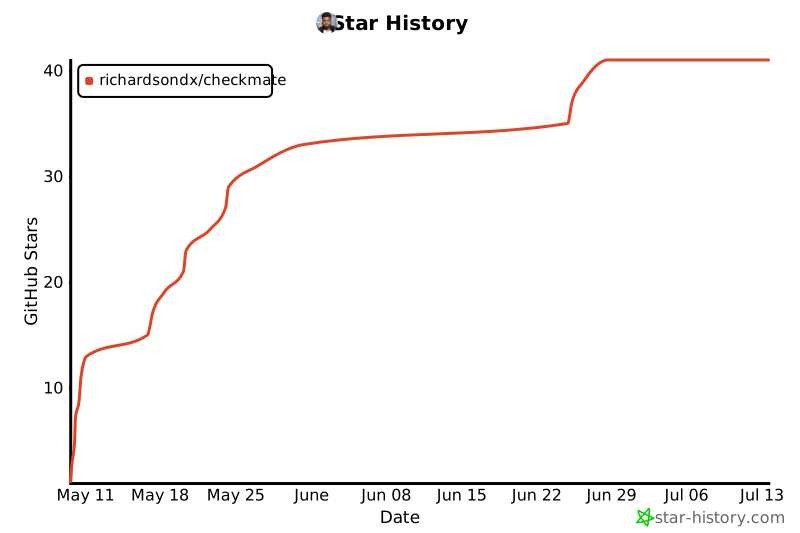
## Star History
[](https://www.star-history.com/#richardsondx/checkmate&Date)
## Contributing
PRs welcome. Keep each change small and include a spec that proves it works.
See [CONTRIBUTING.md](CONTRIBUTING.md) for details.
## License
MIT
See [LICENSE.md](LICENSE.md) for details.
Quick Start
Clone the repository
git clone https://github.com/richardsondx/checkmateInstall dependencies
cd checkmate
npm installFollow the documentation
Check the repository's README.md file for specific installation and usage instructions.
Repository Details
Recommended MCP Servers
Discord MCP
Enable AI assistants to seamlessly interact with Discord servers, channels, and messages.
Knit MCP
Connect AI agents to 200+ SaaS applications and automate workflows.
Apify MCP Server
Deploy and interact with Apify actors for web scraping and data extraction.
BrowserStack MCP
BrowserStack MCP Server for automated testing across multiple browsers.
Zapier MCP
A Zapier server that provides automation capabilities for various apps.